Don't Panic — It's Usually a Simple Fix
You flip the switch and... nothing. Or worse, a humming sound and then nothing. Before you reach for the phone, know that most garbage disposal problems are simple fixes you can handle yourself in a few minutes. Here's a step-by-step checklist to walk through.
Safety First
Before you do anything, turn off the power to the disposal. Unplug it from the outlet under the sink, or flip the breaker at your electrical panel. Never — ever — put your hand into a disposal that still has power connected to it. The blades are sharp and the motor is strong. We can't stress this enough.
Problem 1: The Disposal Won't Turn On at All
Check the reset button. Most disposals have a red reset button on the bottom of the unit. If the disposal overheated or jammed, this button pops out. Press it back in, then try the switch again.
Check the breaker. If the reset button doesn't help, check your electrical panel to see if the breaker tripped. Flip it off and back on.
Check the outlet. If neither of those works, the outlet itself may have failed. Plug something else into the outlet to see if it has power. If not, you may have an electrical issue, not a disposal issue.
Problem 2: The Disposal Hums but Doesn't Spin
This means the motor is getting power but the blades are jammed. Something is stuck — usually a piece of food, a bone, or a utensil that slipped in.
How to fix it:
- Turn off the power. Unplug the disposal or flip the breaker.
- Use an Allen wrench. Most disposals have a small hex-shaped hole on the bottom center. Insert an Allen wrench and turn it back and forth to free the jam. This manually turns the blades and dislodges whatever is stuck.
- Remove the obstruction. Once the blades move freely, use tongs — not your fingers — to pull out whatever was jamming it.
- Restore power and test. Run cold water and turn the disposal on. It should work now.
Problem 3: The Disposal Drains Slowly or Not at All
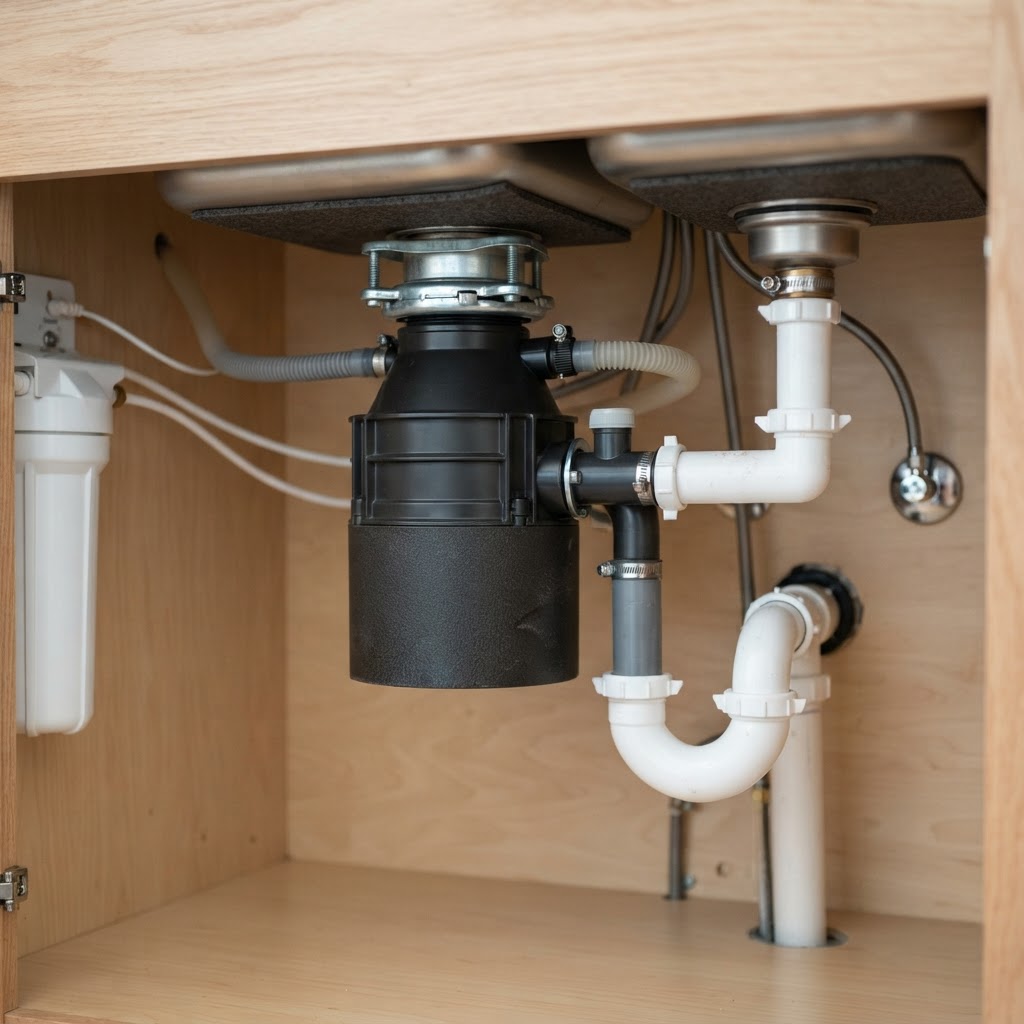
If the disposal runs but water won't go down, you have a clog — but it may not be in the disposal itself. The clog is likely in the trap (the U-shaped pipe under the sink) or further down the line.
How to fix it:
- Run cold water while the disposal is on for 30 seconds — sometimes this clears a minor clog.
- If that doesn't work, place a bucket under the trap, unscrew the slip nuts, and remove the trap. Clean it out and reinstall it.
- If the clog is further down the line, you may need a plumber's snake or a professional drain cleaning.
Problem 4: The Disposal Leaks
Leaks usually come from one of three places: the sink flange (where the disposal meets the sink), the dishwasher connection, or the drain pipe connection.
- Sink flange leak: The putty seal under the flange has failed. This requires loosening the disposal, resealing with new plumber's putty, and reattaching.
- Dishwasher connection: The hose clamp may be loose. Tighten it or replace the hose.
- Drain pipe connection: The gasket or mounting bolt may be worn. Replace the gasket.
What NOT to Put in Your Disposal
Preventing disposal problems is easier than fixing them. Avoid putting these down the drain:
- Grease and oil — they solidify and clog the pipes
- Eggshells — the membrane wraps around the blades
- Coffee grounds — they clump and form sludge
- Pasta and rice — they expand in water
- Bones — they jam the blades
- Fibrous foods like celery, onion skins, and corn husks — the fibers tangle in the blades
When to Call a Plumber
If you've worked through this checklist and the disposal still isn't working, or if you're not comfortable doing any of these steps, it's time to call a professional. Sometimes a disposal has simply reached the end of its life — most last 8-15 years. At All American Plumbing, we can repair or replace disposals throughout the Brownsboro and East Texas area, and we'll tell you honestly whether yours can be fixed or needs replacing.